
2

Buidling Big Thighs Like Tom Platz
Want Big Thighs? Here's Your Guide
To build big thighs, you've got to squat. BIG. You don't need a lot of sets, but you do need a lot of reps. With as heavy weight as possible. You should really be heaving when you're done with each set.

Best legs ever?
Building massive thighs also means training with variety, especially in terms of sets and reps. Your exercises will stay the same, for the most part.
Here's a typical weight training program:
- Pre-exhaust the quadriceps with Leg Extensions. Follow up immediately with heavy squats. Do 4 sets of 15 reps of both extensions and squats.
- Follow up with Leg Presses. These build big quads and hamstrings. You can really isolate the quads with this one. Do 3 sets of 10, using a LOT of weight
- Leg curls. Do 4 sets of 20 reps.
You can vary your training by doing a week of just squats. Try for 7 sets of 20 reps. Couple this with stiff-legged deadlifts to work the hamstrings. This is a very simple program for building tremendous upper leg mass.
Image source: http://www.gym-talk.com/tom-platz-leg-workout/
Building Big Lats — Wider, Thicker, and Longer
Want To Build Big Lats? Here's How
 Big lats are a necessity on a well-rounded, symmetrical physique. Building the latissimus dorsi muscles, rhomboids, trapezius, and other supporting muscles of the back. There are only a few movements that you need to perform to build the muscles of the back.
The king of all lat work is the bent-over barbell row. Using an overhand grip, hands shoulder-width apart, bend slightly at the knees and bend at the waist with your torso slightly above parallel. Pull the bar to your lower ribcage, trying to use your hands and arms as “hooks” only, to maximize the effect on the lats. If you pull the bar higher up on the torso, like to the chest, you'll involve the upper lats, rhomboids, and trapezius more. Pull to the waist, and you're building primarily the lower lats as they taper into the waistline.
Follow the bent-over rows with lat pull-downs. Again, you can influence which area of the latissimus that you effect simply by pulling the par to that area. For example, if you're trying to develop the lower lats, pull the bar down to your belly button. These are great for building thickness in the upper- to mid-back.
The trick to doing this exercise most effectively, is to lean back a bit so that your body is about 30-40 degrees from vertical. In effect, you're doing a variation on the bent-over row you just performed, but you're putting your lower back in a more advantageous position. Plus, you can use a lot more weight, especially if you use the part of the exercise machine that secures your knees, disallowing the weight to pull up your body.
You can also vary your hand position to effect a different part of the back. A wider grip will work on width, whereas a narrower grip will work on thickness.
A variation of the bent-over row is the dumbbell row. Doing these one arm at a time, you can really focus on feeling the muscles work, rather than focusing on getting the weight up. Let your shoulders drop as you extend your arm, and really pull back on the shoulder blades as you raise your arm.
An auxillary exercise you do, most often when trying to build the chest, is the bent-arm pullover. You may not realize this, but the muscles worked with this movement are the lats!
Couple the bent-arm pullover with the bent-over rows in a pre-exhaust superset. The pullovers fatigue the lats, and the rows blast them into oblivion! Repeat this superset 3-5 times, and you've gone a long way to building big lats.
1
Big Shoulders Made Simple
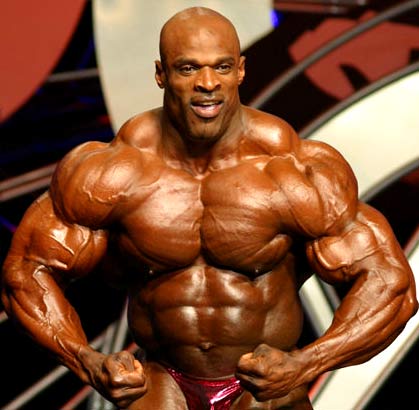 Building big shoulders is easy if you know how to do it. The deltoids consist of three parts: The anterior (or front), the lateral (or side), and the posterior (or back). In order to fully develop the shoulders, you need to build all three of these heads.
Your front delts are stressed through bench presses and shoulder presses. You normally don't have to perform an isolation movement for the fronts. And the rears are stimulated to a lesser degree by bent-over rows and lat pull-downs. However, your side delts really are not worked out at all by the complex movements advocated here at Muscle-Build.com. Therefore, if you want to build big shoulders, you'll need to supplement your weight training with some isolation moves.
Here's a great delt work-out if you want wider, more developed shoulders:
- Side laterals. Using dumbbells at your side, raise them in an arc such that when you're finished you will have formed a “T” with your arms. As a variant, you can do these slightly bent at the waist to involve the lateral and posterior deltoids. Do 3 sets of 10-15 reps.
- Rotating dumbbell presses. Starting at the chin, with hands in the finish position of a dumbbell curl, press the dumbbells up while rotating the arms to finish in a dumbbell press position. In effect, you're working the front delt, but also involving the lateral delt with the rotation. Do 3 sets of 10-15 reps.
- Bent-over laterals. Similar to the side laterals above, you do the same motion, only with your torso parallel to the floor. Do 2 sets of 10-15 reps.
- Upright rows. Using a barbell, with a 6-12 inch overhand grip, hands at the waist, pull the barbell up to your chin. This exercise works all three heads of the deltoid as well as the trapezius, that triangle-shaped muscle that tapers from the neck into the shoulders. Do 2 sets of 10-15 reps.
This shoulder routine will blast your delts and force them to grow. If you want barndoor-wide delts, follow this work-out routine.
Add An Inch To Your Arms In Just A Few Work-Outs

Photo courtesy Lin Mei. License information below.
Bigger arms are just a few weeks away if you follow this guide on how to add an inch to your arms.
Your biceps and triceps generally are easy-gainers, in relation to other body parts like the calves, thighs, or lats. This work-out guide will lay out how you can gain up to one-inch on your arm measurement in less than a month. In fact, some have reported gaining an inch in only a week!
The key is to focus, focus, and FOCUS on your arm development. You will have to reduce your training in other areas to allow your body to synthesize the protein and adapt to this rather rigorous schedule.
You'll be doing supersets, forced reps, negatives, and partial movements in this exercise routine. You'll also be lifting heavy and light, alternating every workout. Put this arm exercise at the front of your “Arms and Legs” day and scale back your really heavy squats and leg presses.
REMEMBER, this type of training can only be implemented every few months, or else you'll over-train and your gains may turn into losses. To add an inch to your arms, you'll need to follow this routine sparingly. But, repeat as necessary.
Add An Inch To Your Arms In NO TIME FLAT
Here's how your workout will look in Weeks 1 through 4, assuming you train for 4 weeks. Rotate through the sequence. Train your arms 3 to 4 times a week, by training them every other day (don't take the traditional 2 days of rest in a row in a 7-day week).
Day 1
- Superset of 2 sets each of barbell curls and tricep extensions (8-12 reps each)
- Superset of 2 sets each of incline dumbbell curls and tricep push-downs (8-15 reps each)
- Reverse curls (1 set, 8-12 reps)
- Dumbbell tricep extensions (1 set, 8-12 reps)
Day 2
- Giant sets of cheating barbell curls, tricep push-downs, concentration curls, and dumbbell kickbacks. (6-10 reps for 3 sets)
Day 3
- Tri-set of tricep extensions with a barbell, supinating dumbbell curls, and tricep push-downs. 12-15 reps per set, 3 sets
Day 4
- 2 sets of Partial rep curls (do 8 reps halfway up from bottom, 8 reps from top to halfway down, finally 8 full reps)
- 2 sets of Partial rep tricep push-downs (same fashion as the curls above)
- Reverse dumbbell curls, 2 sets, 15 reps
- Hammer curls, 2 sets, 8 hard reps
- Dumbbell kickbacks, 3 sets, 10 hard reps
That's it. Don't forget to take in a weight-gain shake between meals. You will need a LOT of protein to build muscle rapidly under this program. Get plenty of sleep and take a nap after your work-out, too, if you can fit it in. Even a 15 minute cat-nap can work wonders.
In no time, you'll notice bigger biceps and triceps that are better-defined. After this regimen (up to 4 weeks long), you'll want to return to a more sane arm work-out, preferably after your leg routine. At this point, just lift to get a pump for a few sessions, then it's back to normal!
And remember, too, that you can apply the principles in “Add An Inch To Your Arms” to any body-part exercise routine. The key is variety in weights, sets, exercises, and super-setting (whether you do or don't) and eating plenty of protein.
Photo information
License: https://creativecommons.org/licenses/by/2.0/
This image was modified only in size. No cropping or touch up done by Muscle-Build.com.
Advanced Bodybuilding
 After about a year of weight training, you'll be ready for Advanced Bodybuilding. Typically, you will have made a HUGE improvement in your body over the course of your first year of training, after following the Beginning and Intermediate bodybuilding phases.
Now, you're a veteran weight trainer. You most likely have experienced some plateaus in your progress; it's in this phase where you learn a WHOLE lot about getting out of training ruts, sticking points, and leveled-off progress.
You have learned how to listen to your body's own bio-feedback and you know how your body best adapts to weight training, diet, and rest. By now, you should know EXACTLY what your body needs in terms of caloric intake, rest and sleep, and supplementation.
Advanced bodybuilders can continue on the 4-day split routine you started with in the Intermediate phase, or you can go to a 6-day split, where you split your body into thirds. It's up to you and your body.
You should also add in more isolation movements and do more sets. Typically, you can do 2-3 exercises per bodypart for 3-5 sets per exercise. Stick to 6-10 reps for building mass, 10-15 reps for building endurance and cutting up (reps should be higher for the legs — 10-15 for mass, 15-20 for definition).
At this point, too, your body has become accustomed to just about anything you've thrown at it, so you'll need to change things up quite a bit to “keep it guessing.” For instance, when training the pecs, one day you can train for 5 sets of 10, the next chest workout you can train for 2 sets of 6, 1 set of 8, 1 set of 10, and one set of 15.
Variety is indeed the spice of the advanced bodybuilding life. It will allow you to keep growing and your muscle “quality” will get better and better the more you change your workouts.
If you ever get to the point where you can't make gains NO MATTER WHAT, try the Hard Gainers Workout, switching to a 3 times per week regimen that's heavy on calories, supplementation, and High Intensity Training (HIT).
Image credit: License for re-use – https://i.ytimg.com/vi/zEK3_igC95k/hqdefault.jpg

Want Faster Results?
Look, I know how hard it is to build muscle. Trust me when I tell you it took me 20+ years to figure it out. But once I did--BAM!--muscle appeared almost overnight. Give me your email address and I'll send you the keys.