
Eggs are the Perfect Muscle-Building and Fat-Loss Food

Eggs are a perfect protein source
Eggs are the perfect muscle-building food: They’re protein-dense, promote fat loss, and the bad cholesterol image they’ve been saddled with was completely overblown!
Eggs offer the most complete source of protein from food (as opposed to supplements); in fact, they’re the yardstick that all other foods fail miserably at measuring up to. The “biological value” (BV) of the egg is 100 on a scale of 1 to 100. Cow’s milk, for example, comes in at 91 while beef comes in at 80 (wikipedia).
On a side note, whey protein isolate (from cow’s milk) comes in at a whopping 104! This is the primary reason that you should be ingesting, and investing in, whey protein powders mixed with milk.
Coupled with its small size, the egg gives you a lot of protein for its small weight. In other words, it’s protein rich and nutrient dense.
Don’t worry, either, about the fat or the cholesterol in eggs (if you’re a healthy individual): You will not increase your body fat or cholesterol levels by ingesting several eggs a day. In fact, you could probably eat a dozen eggs a day for several weeks in a row (if not months) and not suffer any ill consequences.
The egg is an ideal source of protein, offering all of the essential amino acids your body needs. Plus, eggs have an incredible anabolic effect on a person’s body. Old timers like the late Vince Gironda used to prescribe dozens of eggs a day to his pupils during their brief (3 to 6 weeks) “bulking up” phases. This super food causes an outpouring of human growth hormone, which helps immensely in BOTH muscle-building and fat-loss efforts.
In short, you will build muscle and drop bodyfat by making intelligent use of eggs in your diet.
Give them a try! You’ll like the results.
1
Should You Bulk or Cut?
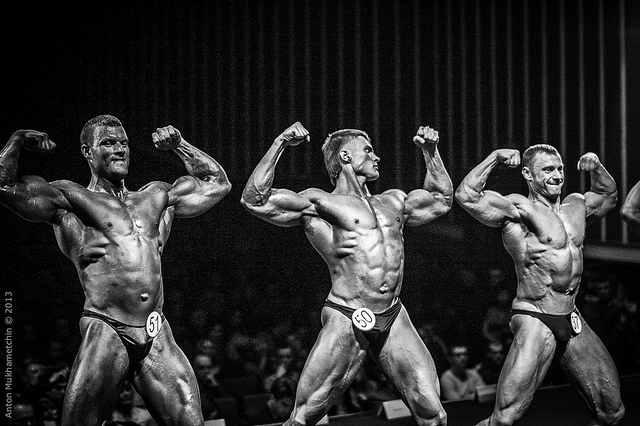
Let me preface this by saying that “bulking” means putting on 1 or 2 pounds a month.
The 5-10 pound-a-month bulks are dumb as hell.
That said, dudes are either bulking or cutting.
Am I right?
You are either trying to add muscle mass or lose fat.
There is no “maintaining” when it comes to bodybuilding.
So, how are you supposed to know which to choose?
Bulk or cut?
I have 3 keys when it comes to making this decision.
3 keys for making the ‘bulk or cut’ decision
1. The 15% Body Fat Rule
This is something I came up with.
I tell guys that if they are at or above 15% body fat then they should cut.
If, on the other hand, they are under 15% body fat then they should bulk.
Under 15% —> Bulk
Over 15% —> Cut
There are several reasons for this.
The leaner you are, the easier it is for you to build muscle.
The fatter you are, the more likely it is that excess calories will be stored as fat.
Insulin sensitivity is also negatively affected the fatter you are.
2. The time of year
Normally, guys bulk during the winter and cut during the summer.
The reasoning is that you can put on some fat and cover it up with sweaters during the winter and then you cut the fat and show off the abs during beach season.
This makes sense.
You can do it this way or switch it up and do something that hardly anyone does.
You can cut during the winter and bulk during the summer.
I’ve been meaning to do it that way just out of curiosity.
3. Personal Preference
Look, I can tell you why you should bulk or should cut, but what it really comes down to is personal preference, i.e., what do you want to do?
So, if you’re at 20% body fat and love eating and gaining muscle, then go ahead and bulk.
If you are 6 feet tall, weigh 160 pounds with 8% body fat and want to cut, then go ahead and cut.
After all, you have to enjoy what you do or what’s the point, right?
So, hopefully this helps you make the ‘bulk or cut’ decision a little easier.
I have given you guidelines, not rules.
Just out of curiousity, how do you decide when to bulk and when to cut?
Photo credit: Anton Mukhametchin
Build Mass Without Side Effects

by Anonymous
Question: I am very lean and my body weight is very low compared to my height. So please guide me to increase my body mass safely without any side effects.
Answer: You are certainly not the first – nor will you be the last – person to experience this issue!
My standard answer is if you are not gaining weight, then you aren’t eating enough. It is a simple math problem.
Building muscle is a little different. You have to actually exercise by overloading your muscles and then letting them rebuild so that they are bigger and stronger than before.
But putting on weight is simply a math problem:
Eat more calories than you burn.
It really is that simple. Now, I know. It’s extremely difficult to eat a lot of food for a lot of people; I used to be the same way. I used to eat so much that I literally puked it all out. It was absolutely horrible!
You will need a good protein supplement, preferably made of whey concentrate. Prograde makes the best on the market, so you may as well pick some up right now.
Eat 6 or more times a day, including plenty of protein and fat from eggs, milk, beef, fish, fowl, and nuts. Make sure you eat a lot of green vegetables and fresh fruits, too.
For short periods of time (3 to 6 weeks), you can eat up to a dozen eggs and a gallon of milk per day. Don’t start off with this volume, though — build up to it!
Get in the gym no more than 3 days a week and exercise using only compound movements like squats, deadlifts, chinups, bench presses, rows, and overhead presses. 3 sets of 6-10 reps.
Don’t do any abdominal work and rest as much as possible. Sleep at least 8 hours a night. More if you can. Take a nap after lunch, too.
The trick is getting your metabolism to slow down, stimulating muscle growth, and eating as much as you can to effect the weight and muscle gains that you so desperately desire.
It IS do-able. I put on over 60 pounds in one year using those methods above.
You can get more details by getting my Hardgainer Manifesto course.
Image credit: https://upload.wikimedia.org/wikipedia/commons/b/b5/Ronnie_Coleman_8_x_Mr_Olympia_-_2009_-_7.png


Want Faster Results?
Look, I know how hard it is to build muscle. Trust me when I tell you it took me 20+ years to figure it out. But once I did--BAM!--muscle appeared almost overnight. Give me your email address and I'll send you the keys.